Introduction: Growing Up in a Digital World
From online classrooms and educational videos to smartphones, tablets and video games, digital screens have become an integral part of childhood. While technology offers significant educational and social benefits, its increasing use has raised important questions about children's visual comfort, ocular development and long-term eye health.
Parents frequently ask:
Can prolonged screen time damage my child's retina?
Does blue light cause permanent eye damage?
How much screen time is acceptable?
Can simple eye exercises prevent vision problems?
These questions deserve evidence-based answers rather than fear-driven advice.
The first important distinction is this: digital eye strain, childhood myopia and retinal disease are different clinical concerns. They may overlap in the broader discussion of children's visual health, but they have different mechanisms, risk factors and management strategies.
Current evidence does not establish that ordinary screen exposure directly damages a child's retina. However, prolonged near work, reduced blinking, insufficient outdoor activity, poor visual ergonomics and screen use close to bedtime can create problems that deserve attention.
Protecting children's eyes is therefore not simply about switching off devices. It is about establishing healthy visual habits, recognising early symptoms and ensuring appropriate eye examinations when needed.
1. Understanding How Screen Time Affects Children's Eyes
Children's visual systems undergo significant development during infancy and childhood. Their eyes must learn to coordinate focusing, alignment and binocular vision while adapting to changing visual demands.
Digital screens require sustained near fixation. During prolonged use, the eyes repeatedly maintain accommodation—the process of adjusting focus for near objects—and convergence, the inward movement of the eyes required for binocular viewing at close distances.
When near work continues without adequate breaks, some children may develop symptoms collectively described as digital eye strain, or digital-related asthenopia.
Common symptoms of digital eye strain
Children may experience:
Tired, aching or uncomfortable eyes.
Dryness, burning, irritation or excessive watering.
Intermittent blurred vision, particularly after prolonged near work.
Headaches around the forehead or temples.
Difficulty refocusing when looking away from a screen.
Squinting, rubbing the eyes or losing concentration during visual tasks.
These symptoms are often temporary and improve with rest or changes in viewing habits. Persistent symptoms, however, should not automatically be attributed to screens. Uncorrected refractive errors, accommodative dysfunction, convergence problems, ocular surface disease and other conditions may produce similar complaints.
Clinical perspective: A child who repeatedly complains of headaches or blurred vision after reading or screen use may benefit from a comprehensive eye examination rather than simply being told to reduce mobile phone use.
Reference: American Academy of Ophthalmology (AAO), Digital Devices and Your Eyes.
2. Can Screen Time Damage a Child's Retina?
The retina is a specialised, light-sensitive neural tissue lining the back of the eye. It converts incoming light into electrical signals that travel through the optic nerve to the brain, allowing us to see.
Because retinal tissue is essential for vision, concerns about potential light-related injury are understandable. However, it is important to distinguish the effects of intense or hazardous light exposure from ordinary use of consumer electronic devices.
What does the evidence tell us?
The light emitted by standard smartphones, tablets, televisions and computers has not been demonstrated to cause retinal damage under normal viewing conditions.
Laboratory research involving particular light intensities, exposure durations or experimental conditions cannot automatically be translated into evidence of injury from everyday screen use.
At present, there is no established evidence that ordinary screen use directly causes retinal degeneration in otherwise healthy children.
Nevertheless, responsible eye care requires us to consider the indirect effects of prolonged screen use, including reduced outdoor time, sustained near work and possible associations with childhood myopia.
Why does myopia matter for retinal health?
Myopia, commonly called short-sightedness, occurs when distant objects appear blurred. In many cases, the eye becomes longer than normal, causing incoming light to focus in front of the retina rather than directly on it.
High myopia is clinically important because excessive axial elongation can stretch and thin the retina and other posterior ocular structures. This can increase the lifetime risk of complications such as myopic maculopathy, retinal tears and retinal detachment.
This does not mean that screen time inevitably causes myopia or retinal disease. Myopia is multifactorial, involving genetic susceptibility, environmental influences and visual behaviours.
However, preventing or slowing excessive myopia progression is an important part of long-term ocular health.
Reference: AAO, Preventing Childhood Myopia Through Outdoor Activity.
3. Blue Light: Separating Scientific Evidence from Common Myths
Blue light is part of the visible light spectrum and is naturally present in sunlight. Digital screens also emit blue wavelengths, generally at much lower intensities than daylight.
Blue light performs important physiological functions. Exposure to light helps regulate circadian rhythms, alertness and the sleep–wake cycle.
The concern is not that all blue light is harmful, but whether the intensity, duration and timing of exposure may affect particular aspects of health.
Myth 1: Blue light from mobile screens permanently damages the retina
Evidence-based answer: Current evidence does not demonstrate retinal injury from ordinary screen-level blue-light exposure in children.
It is inappropriate to equate the exposure conditions used in some experimental studies with everyday smartphone or tablet use.
Myth 2: Every child who uses a screen needs blue-light-blocking glasses
Evidence-based answer: Blue-light-filtering spectacles have not been established as necessary for preventing retinal damage from digital devices.
They should not replace appropriate refractive correction, visual breaks, good sleep habits or a clinical assessment when symptoms persist.
Some children may report subjective comfort with particular lenses, but this is not the same as proving that the lenses prevent eye disease.
Myth 3: Blue light is the main cause of digital eye strain
Evidence-based answer: Digital eye strain is more closely associated with prolonged near work, reduced or incomplete blinking, focusing demands, glare, viewing distance and other ergonomic factors.
Blue light is not considered the principal established cause of screen-related eye discomfort.
What about sleep?
Even though retinal injury from ordinary screen exposure has not been established, screen use in the evening may interfere with sleep. Light exposure can suppress melatonin and influence circadian timing, while stimulating content may also delay bedtime.
A practical approach is to reduce screen use before sleep, maintain a consistent bedtime and use comfortable lighting. Night mode may reduce short-wavelength output and glare, but it does not eliminate the need for healthy screen habits.
Reference: Association of Optometrists, Screen Time: Facts for Parents.
4. Screen Time and Childhood Myopia: What Parents and Clinicians Should Know
The rising prevalence of myopia worldwide has made childhood visual development an important public-health concern.
Research suggests an association between greater digital screen exposure and myopia, although the relationship is complex. Screen use often occurs alongside prolonged near work and less time spent outdoors, making it difficult to attribute risk to screens alone.
A 2025 systematic review and dose-response meta-analysis published in JAMA Network Open analysed 45 studies involving 335,524 participants. It reported an association between increasing digital screen time and greater odds of myopia. Such findings support preventive attention but does not, by themselves, establish that screen exposure alone causes myopia in an individual child.
Practical strategies to support healthy visual development
1. Encourage regular outdoor activity.
Spending time outdoors is associated with a lower risk of developing myopia, particularly in children who have not yet become short-sighted. Outdoor activity is not a guaranteed preventive measure, but it is an important, practical component of healthy visual development.
2. Break up prolonged near work.
Encourage children to alternate close-up tasks with activities that allow them to look into the distance. The same principle applies to printed books, drawing and other sustained near tasks—not just electronic screens.
3. Avoid excessively close viewing.
Children should not hold smartphones close to their faces for prolonged periods. Encourage a comfortable viewing distance and a relaxed posture.
4. Ensure appropriate refractive correction.
A child who struggles to see the classroom board, squints frequently or holds books unusually close should have their vision assessed.
5. Monitor children with established myopia.
Once myopia is diagnosed, regular follow-up is important to monitor refractive change and, when clinically indicated, axial length. Evidence-based myopia-control options may be considered by an appropriately trained eye-care professional.
The objective is not to eliminate near work altogether. It is to balance near activities with outdoor time, visual breaks and appropriate clinical care.
Reference: Digital Screen Time and Myopia: A Systematic Review and Dose-Response Meta-Analysis.
5. How Much Screen Time Is Appropriate for Children?
There is no single screen-time threshold that guarantees protection from eye strain or myopia. Recommendations also differ by age, purpose of use, developmental needs and the balance between screen use and other activities.
For children younger than five, the World Health Organization provides age-specific guidance on sedentary screen time as part of its broader recommendations for physical activity and sleep.
Infants and children younger than two: Avoid routine sedentary screen time, apart from appropriate exceptions such as interactive video communication.
Children aged two to four: WHO guidance recommends no more than one hour of sedentary screen time per day, with less being preferable.
School-aged children and adolescents: Set reasonable, age-appropriate limits that preserve adequate sleep, physical activity, outdoor play, face-to-face interaction and study time.
Educational requirements may make complete avoidance unrealistic for older children. In such cases, focus on how devices are used, how long children remain continuously engaged in near work, and what screen activities are displacing.
Parents should also establish screen-free periods during meals, family interactions and the hour before bedtime where practical.
Reference: World Health Organization, Guidelines on Physical Activity, Sedentary Behaviour and Sleep for Children Under 5 Years.
6. The 20-20-20 Rule: A Simple Habit for Visual Relaxation
One of the easiest strategies for reducing digital eye strain is the widely used 20-20-20 rule.
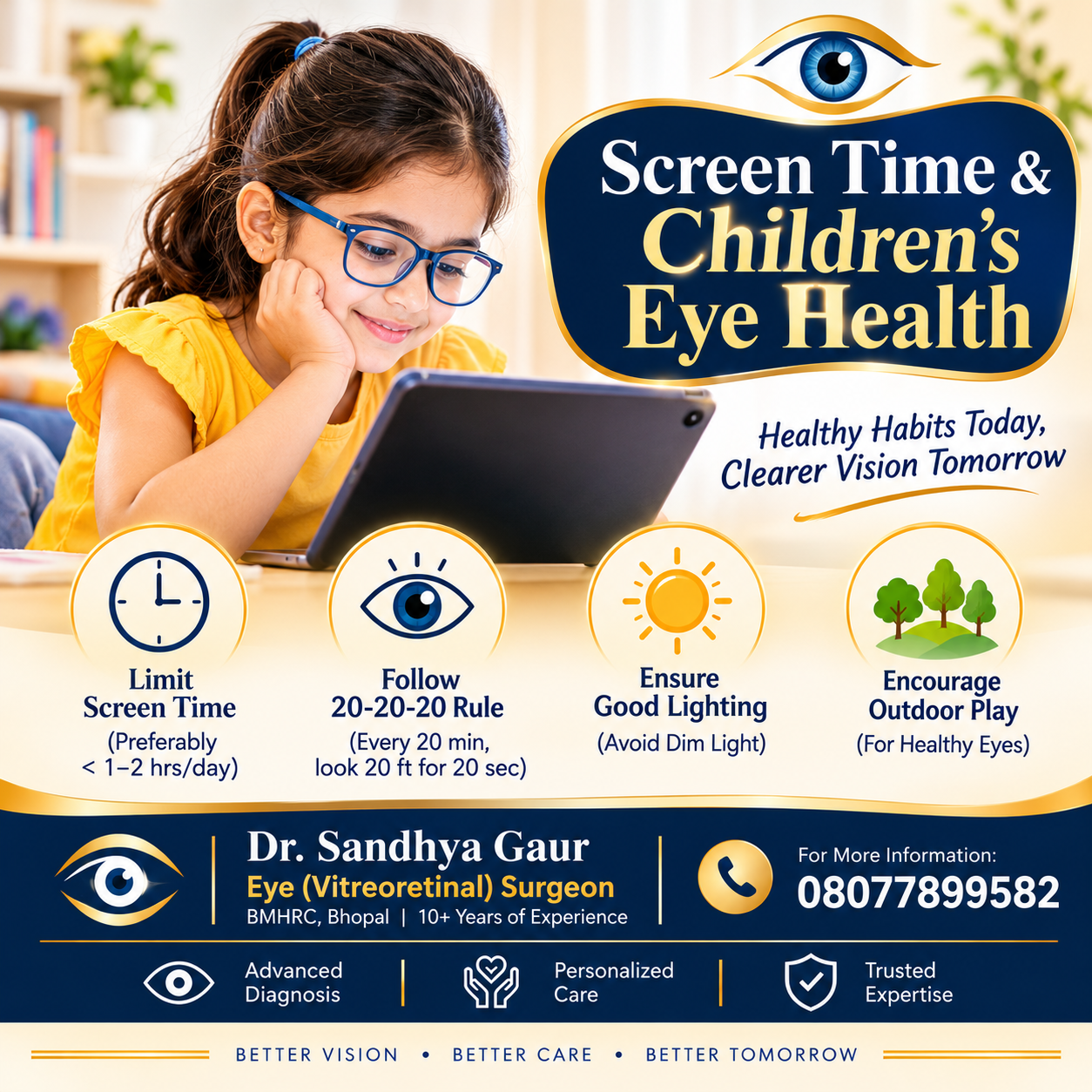
After approximately every 20 minutes of continuous near work, encourage the child to look at an object around 20 feet (6 metres) away for at least 20 seconds.
This provides a useful reminder to interrupt sustained near fixation. It is a practical habit rather than a clinically validated guarantee against myopia or retinal disease.
Additional techniques for eye comfort
Conscious blinking: Children often blink less frequently or incompletely while concentrating on screens. Encourage several gentle, complete blinks during breaks to help spread the tear film over the ocular surface.
Distance viewing: Ask the child to look out of a window or towards a distant object rather than immediately switching to another nearby screen.
Comfortable posture: Use a chair and desk that support a relaxed posture. Position the screen at a comfortable distance, generally about an arm's length for larger displays, with the gaze slightly downward where practical.
Glare control: Reduce reflections from windows and overhead lights. Adjust the display brightness and text size to comfortable levels.
Appropriate lighting: Avoid using bright screens in a completely dark room for extended periods. Balance screen brightness with the surrounding environment.
Regular movement: Encourage children to stand up, stretch and move around during breaks. This benefits general well-being as well as reducing prolonged sedentary behaviour.
These strategies can help relieve discomfort, but they should not be presented as treatments for retinal disease or substitutes for an eye examination.
7. Do Eye Exercises Strengthen the Retina?
This is an important distinction for parents, students and healthcare professionals.
The retina is neural tissue. Ordinary eye-relaxation exercises do not strengthen retinal tissue, reverse axial elongation or prevent retinal detachment.
Looking into the distance may help relieve the discomfort associated with sustained near focusing. Blinking can improve tear-film distribution, while appropriate breaks may reduce visual fatigue.
However, these benefits should not be confused with treatment of an underlying ocular disorder.
Certain structured orthoptic or vergence exercises may be prescribed for specific diagnosed binocular-vision conditions. They are not universally necessary and do not treat every cause of headache, blur or eye strain.
Children with persistent symptoms require an assessment to identify the underlying cause before exercises or other treatments are recommended.
8. When Should Parents Seek an Eye Examination?
Children do not always recognise or communicate changes in their vision. Some adapt to blurred vision without realising that what they see is abnormal.
Parents and teachers should watch for the following signs:
Frequent squinting or closing one eye to see clearly.
Sitting unusually close to a television or holding books very close.
Difficulty seeing the classroom board.
Recurrent headaches associated with reading or visual tasks.
Persistent redness, irritation, watering or blurred vision.
One eye turning inward or outward.
An apparent difference in vision between the two eyes.
Avoidance of reading, drawing or other visually demanding activities.
These signs do not necessarily indicate retinal disease, but they warrant appropriate evaluation.
Retinal warning signs that must not be ignored
Although uncommon in otherwise healthy children, retinal problems can occur, particularly in children with significant myopia, previous ocular trauma, certain inherited retinal disorders or relevant surgical histories.
Urgent ophthalmic assessment is warranted for:
A sudden decrease or loss of vision.
New flashes of light or a sudden increase in floaters.
A shadow or curtain-like area across the field of vision.
Significant eye trauma followed by visual symptoms.
Parents should not assume that such symptoms are caused by screen fatigue. Sudden visual changes require prompt professional evaluation.
A comprehensive examination may include age-appropriate visual acuity testing, refraction, assessment of ocular alignment and binocular function, and a dilated retinal examination when indicated.
9. Guidance for Medical Students and Eye-Care Professionals
For medical trainees and clinicians, the growing use of digital devices offers an opportunity to approach paediatric visual complaints systematically rather than attributing every symptom to screen exposure.
A practical clinical framework
History: Establish the child's age, duration and pattern of near work, viewing distance, outdoor activity, sleep routine, family history of myopia, previous spectacle prescription and symptom chronology.
Visual assessment: Measure age-appropriate visual acuity in each eye. Assess refraction, ocular alignment, accommodation and convergence according to the clinical presentation.
Ocular surface evaluation: When dryness, burning or watering is reported, consider reduced blinking, incomplete blinking, environmental factors and tear-film dysfunction.
Myopia assessment: Determine refractive status and progression. Axial-length measurement may provide useful additional information where available and clinically appropriate.
Posterior-segment evaluation: A dilated retinal examination should be considered when indicated by the history, degree of myopia, symptoms, ocular findings or relevant risk factors. It is not necessary to assume that every child with digital eye strain has retinal pathology.
Counselling: Offer specific, realistic advice on breaks, viewing distance, outdoor activity, sleep hygiene and symptom monitoring. Avoid unsupported claims that blue-light glasses or eye exercises prevent retinal damage.
Follow-up: Arrange review according to the diagnosis and level of risk. Children with progressive myopia or an identified ocular disorder may need more structured monitoring than children with occasional, uncomplicated digital eye strain.
This approach supports appropriate diagnosis, reduces unnecessary alarm and helps ensure that significant ocular conditions are not overlooked.
10. A Practical Daily Eye-Health Routine for Families
A consistent family routine is often more sustainable than strict rules that are difficult to maintain.
Morning
Begin the day with a regular sleep–wake routine.
Ensure that any prescribed spectacles are worn as directed.
Encourage outdoor activity when practical.
During school and study
Maintain comfortable viewing distances and adequate lighting.
Take regular breaks from continuous near work.
Encourage complete blinking and occasional distance viewing.
After school
Balance educational and recreational screen use with outdoor play, physical activity and social interaction.
Avoid replacing one screen with another during every break.
Observe whether the child develops recurring headaches, blurred vision or discomfort.
Evening
Reduce recreational screen use before bedtime.
Keep devices out of the sleeping routine where possible.
Prioritise adequate sleep and a calm, consistent bedtime.
Throughout the year
Arrange age-appropriate vision screening and comprehensive eye examinations when indicated.
Follow the recommended review schedule if the child has myopia, a refractive error or another diagnosed ocular condition.
The most effective strategy is not simply to count minutes. It is to create an environment in which children's eyes can function comfortably while their bodies, sleep patterns and visual systems develop.
Frequently Asked Questions (FAQs)
1. Can mobile phones cause permanent retinal damage in children?
Ordinary use of standard digital devices has not been demonstrated to cause permanent retinal damage. Prolonged use can nevertheless contribute to temporary eye strain and may be associated with visual behaviours relevant to myopia risk.
2. Are blue-light-blocking glasses necessary for children?
They are not routinely necessary for preventing screen-related retinal injury. Appropriate visual ergonomics, sleep habits and refractive correction are more important. Persistent symptoms should be evaluated clinically.
3. Does the 20-20-20 rule prevent myopia?
No. It is a practical strategy to interrupt prolonged near work and help relieve visual discomfort. It has not been established as a stand-alone method for preventing myopia.
4. Is reading a printed book safer for the eyes than reading on a tablet?
Both activities involve near focusing. Digital devices may introduce additional glare, viewing-position and blinking issues, but prolonged close work with printed material can also cause discomfort. Distance, duration, breaks and outdoor activity matter.
5. Can outdoor play protect children's eyesight?
Regular outdoor activity is associated with a lower risk of developing myopia. It does not guarantee prevention, and children who already have myopia may require additional management.
6. Should children undergo retinal examinations because they use screens?
Screen use alone does not automatically indicate a need for a dilated retinal examination. The decision depends on symptoms, examination findings, myopia severity, family or medical history and other clinical risk factors.
7. When should screen-related eye strain be investigated?
Arrange an eye examination if discomfort, headaches or blurred vision recur, persist despite reasonable adjustments, or interfere with school and daily activities. Sudden vision loss, new flashes, a sudden increase in floaters or a curtain-like shadow requires urgent assessment.
Conclusion: Healthy Screen Habits Begin with Informed Choices
Digital technology is an established part of modern childhood. The goal is not to create unnecessary fear around screens, but to help children use them in ways that support visual comfort, healthy development and overall well-being.
Current evidence does not establish that ordinary screen exposure directly damages the retina. However, prolonged near work, reduced blinking, insufficient outdoor activity and disrupted sleep are important considerations in a child's broader visual-health routine.
For parents, this means setting sensible boundaries, encouraging outdoor play, maintaining comfortable viewing habits and recognising symptoms that deserve professional attention.
For medical students and eye-care professionals, it means distinguishing digital eye strain from myopia and retinal pathology, communicating evidence accurately and individualising care according to each child's needs.
Healthy eyes are supported by balanced habits, timely assessment and evidence-based care—not by fear of technology.
About the Author
Dr. Sandhya Gaur
Eye (Vitreoretinal) Surgeon
BMHRC, Bhopal | 10+ Years of Experience
Dr. Sandhya Gaur focuses on retinal and vitreoretinal eye care, with an emphasis on patient education, early recognition of vision-related concerns and informed clinical care.
Her educational approach aims to help patients and families understand eye health while supporting awareness among medical students and healthcare professionals.
============================================================================================
SCHEDULE YOUR FREE RETINAL EXAMINATION
Consult with Dr. Sandhya Gaur at BMHRC Bhopal
📍 Location: Bhopal Memorial Hospital & Research Center (BMHRC),Bhopal, MP - 462038
📞 Direct Consultation & Inquiries : 08077899582
Take the step today to protect the way you see tomorrow.
============================================================================================
For More Information: 08077899582
Medical disclaimer: This article is intended for educational purposes and does not replace an individual ophthalmic assessment. Recommendations should be adapted to the child's age, symptoms, examination findings and clinical needs.